
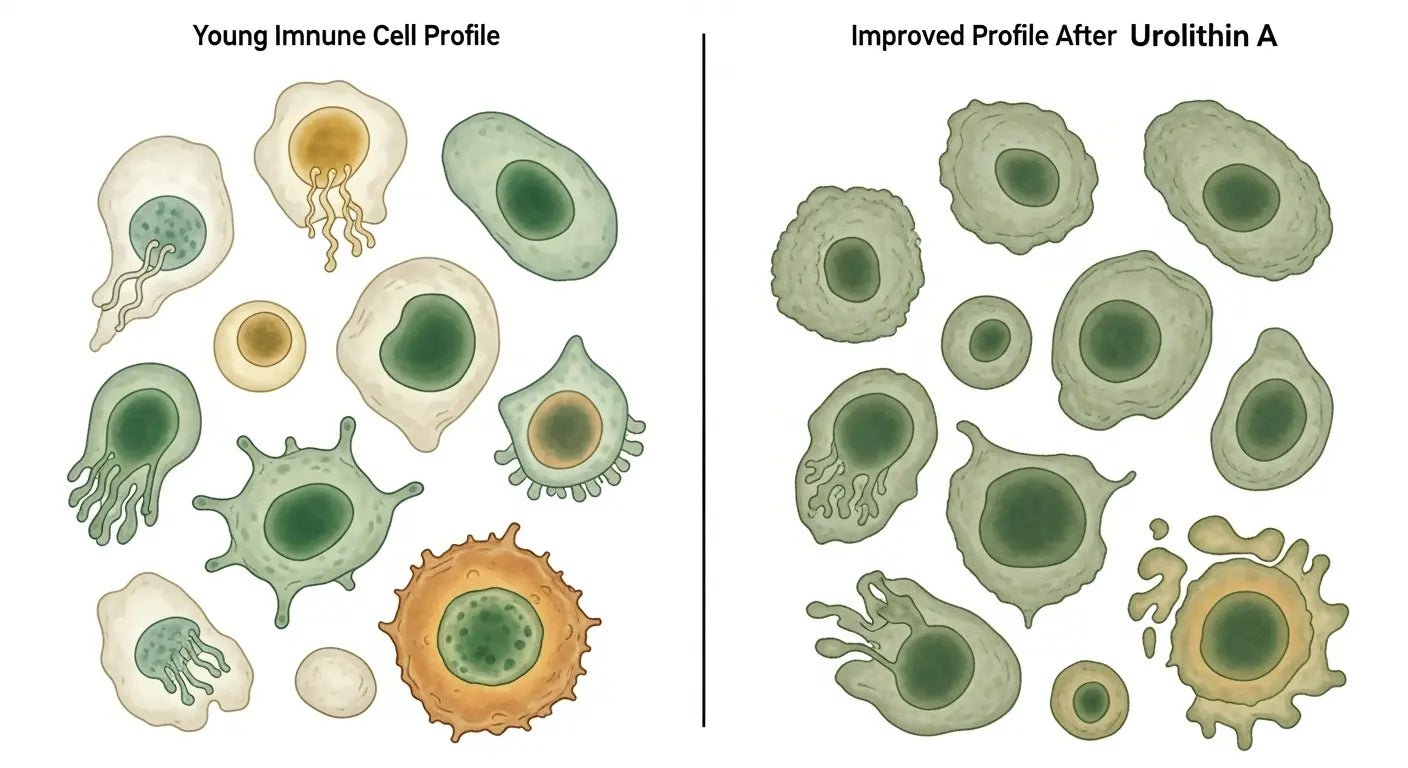
Eine 2025 in Nature Aging veröffentlichte Studie verabreichte 50 Erwachsenen im Alter von 45–70 Jahren über 28 Tage täglich 1.000 mg Urolithin A und untersuchte Veränderungen der Immunzellpopulationen. Das berichtete Ergebnis war eine Zunahme an naiven CD8+-T-Zellen und eine Verringerung von Markern, die mit T-Zell-Erschöpfung assoziiert sind. Es handelt sich um eine kleine, kurze, mechanistische Studie — zwar wirklich interessant, aber noch weit von einem klinischen Ergebnis entfernt.
Dieser Artikel beschreibt, was die Studie gemessen hat, was nicht und wie sie sich in die länger bestehende Evidenz zur Muskelausdauer einordnet.
Kernpunkte
- 50 Teilnehmer, 28 Tage, täglich 1.000 mg — eine mechanistische Studie, keine Ergebnisstudie
- Untersuchte Immunzellpopulationen, keine Infektionen, Krankheiten oder Impfreaktionen
- Zunahme naiver CD8+-T-Zellen; Rückgang von Erschöpfungsmarkern
- Vorgeschlagener Mechanismus ist Mitophagie in Immunzellen
- Muskelausdauer bleibt das besser replizierte Ergebnis für Urolithin A
- Etwa 40–55 % der Menschen produzieren durch Nahrung nennenswerte Mengen an Urolithin A
Was passiert mit dem Immunsystem im Alter
Die Zusammensetzung der Immunzellen verschiebt sich im Laufe eines Lebens. Der Anteil an naiven T-Zellen — jenen, die noch nicht auf ein spezifisches Ziel festgelegt sind — nimmt ab, während Zellen mit Erschöpfungsmarkern häufiger werden. Diese Verschiebung ist in der Immunologie gut beschrieben und einer der Gründe, warum sich Immunantworten bei einem 25-Jährigen und einem 70-Jährigen unterscheiden.
Die Mitochondrienfunktion in Immunzellen ist einer von mehreren Faktoren, die in diesem Zusammenhang diskutiert werden, und sie ist das Bindeglied, das Urolithin A überhaupt erst zu einem testenswerten Kandidaten machte.
Die Studie von 2025 im Detail
| Design | Phase-1, randomisiert, doppelblind, placebokontrolliert |
|---|---|
| Teilnehmer | 50 Erwachsene, 45–70 Jahre alt |
| Dauer | 28 Tage |
| Dosis | 1.000 mg Urolithin A täglich |
| Messungen | Immunzellpopulationen, Erschöpfungsmarker und immunmetabolisches Remodeling |
| Ergebnisse | Naiv-ähnliche, weniger erschöpfte CD8+-T-Zellen nahmen gegenüber Placebo um 0,5 Prozentpunkte zu; die Fettsäureoxidationskapazität der CD8+-Zellen stieg um 14,7 Prozentpunkte |
Was die Studie nicht gemessen hat: ob die Teilnehmer weniger Infektionen hatten, schneller genesen sind, besser auf Impfungen reagiert haben oder irgendeine Veränderung in ihrem Wohlbefinden verspürten. Diese Fragen erfordern ein anderes Studiendesign, mehr Teilnehmer und eine längere Nachbeobachtung.
Auch die Größe der Ergebnisse ist von Bedeutung. Das immunologische Ergebnis war statistisch grenzwertig; das metabolische war robuster. Keines wurde für die Anzahl der Vergleiche bereinigt, die die Studie durchführte — bei vielen gemessenen Endpunkten werden manche Ergebnisse allein durch Zufall den Signifikanzschwellenwert überschreiten.
Eine Veränderung in einer Zellpopulation ist eine biologische Beobachtung. Sie als gesundheitliches Ergebnis darzustellen, ist der häufigste Fehler in der Berichterstattung über diese Studie, und den werden wir nicht begehen.
Warum Urolithin A überhaupt Immunzellen beeinflusst
Urolithin A wird auf seine Wirkung auf die Mitophagie hin untersucht — den Prozess, durch den Zellen beschädigte Mitochondrien abbauen. Immunzellen sind metabolisch anspruchsvoll, und ihre Funktion hängt von der mitochondrialen Kapazität ab.
Die vorgeschlagene Kette lautet: Mitophagie verbessert die Mitochondrienqualität in Immunzellen, was ihre metabolische Kapazität unterstützt, was sich in den gemessenen Populationsmarkern widerspiegelt. Jedes Glied ist plausibel. Die Studie liefert Hinweise für die späteren Glieder, nicht für die Kette als Ganzes.
Das Umwandlungsproblem
Urolithin A kommt in Lebensmitteln nicht vor. Ihre Darmbakterien produzieren es aus Ellagitanninen, die in Granatäpfeln, Walnüssen und einigen Beeren enthalten sind — und nur schätzungsweise 40–55 % der Menschen besitzen die Bakterien, um dies effizient zu tun.
Deshalb verwenden Studien ein Supplement anstatt die Zufuhr über die Nahrung: Es ist der einzige Weg, jedem Teilnehmer eine bekannte Menge zu verabreichen. Dies ist auch der praktische Grund, warum die Verbindung überhaupt verkauft wird.
Was die Muskelforschung dazu beiträgt
Die immunologische Erkenntnis ist neu und nicht repliziert. Die Muskelergebnisse sind beides nicht.
Eine Studie aus dem Jahr 2022 berichtete von Verbesserungen der Muskelkraft über vier Monate bei täglichen Dosen von 500 und 1.000 mg. Ein systematischer Review aus dem Jahr 2024, der fünf randomisierte Studien und etwa 250 Teilnehmer abdeckte, fand einen dosisabhängigen entzündungshemmenden Effekt sowie Verbesserungen der Muskelkraft und -ausdauer, jedoch keine Verbesserung der körperlichen Funktion.
Wenn Sie entscheiden, ob sich die Einnahme von Urolithin A lohnt, ist die Evidenz zur Muskelausdauer das substanziellere Werk. Die Immun-Daten sind ein Grund, das Feld zu beobachten, nicht jedoch ein Grund für sich allein.
Für wen dies tatsächlich relevant ist
Für Erwachsene in dem Alter, das in den Studien untersucht wurde — grob ab 45 Jahren —, bei denen die untersuchte Biologie vorhanden ist. Es ist nicht relevant für akute Krankheiten, es ist keine Alternative zur Impfung, und niemand sollte es in der Erwartung einnehmen, seltener Erkältungen zu bekommen. Diese Frage wurde nicht gestellt, geschweige denn beantwortet.
Wenn Sie verschreibungspflichtige Medikamente einnehmen, schwanger sind oder stillen oder unter einer Immunerkrankung leiden, fragen Sie zuerst Ihren Arzt oder Apotheker.
Häufig gestellte Fragen
Wie groß war die Studie von 2025?
50 Erwachsene im Alter von 45–70 Jahren über 28 Tage bei täglich 1.000 mg. Nach klinischen Standards klein und kurz — angemessen
für eine mechanistische Frage, unzureichend für eine Aussage über gesundheitliche Ergebnisse.
Bedeutet das, dass ich seltener krank werde?
Nein. Die Studie untersuchte Immunzellpopulationen, keine Krankheiten. Diese Frage wurde nicht untersucht.
Wie hoch ist die Dosierung in den Studien?
1.000 mg täglich in der Immunstudie; die Muskelstudien verwendeten 500 oder 1.000 mg.
Kann ich genug über Granatäpfel aufnehmen?
Nur, wenn Sie die Darmbakterien besitzen, die Ellagitannine umwandeln, was bei schätzungsweise 40–55 % der Menschen der Fall ist.
Es gibt keinen Routine-Test.
Ist es sicher mit anderen Nahrungsergänzungsmitteln?
In Studien bis zu vier Monaten wurden keine spezifischen Wechselwirkungen berichtet. Fragen Sie Ihren Apotheker, wenn Sie
verschreibungspflichtige Medikamente einnehmen.
Quellen
- Urolithin A und altersbedingter Rückgang des Immunsystems — RCT, PubMed
- Urolithin A und Muskelausdauer bei älteren Erwachsenen — JAMA Network Open, PubMed
- Urolithin A und Muskelkraft — Cell Reports Medicine, PubMed
- Sicherheit und Mitophagie-Aktivität von Urolithin A — erste Studie am Menschen, PubMed
- Bekämpfung des Alterns mit Urolithin A beim Menschen — systematischer Review, PubMed
- Prävalenz von Urolithin-A-Produzenten bei gesunden Erwachsenen — RCT, PubMed
Aktie:
Nattokinase: Evidenzbasierte Vorteile, Risiken und Wissenswertes
Sommerhaut von innen: Die Wissenschaft der oralen Hyaluronsäure