
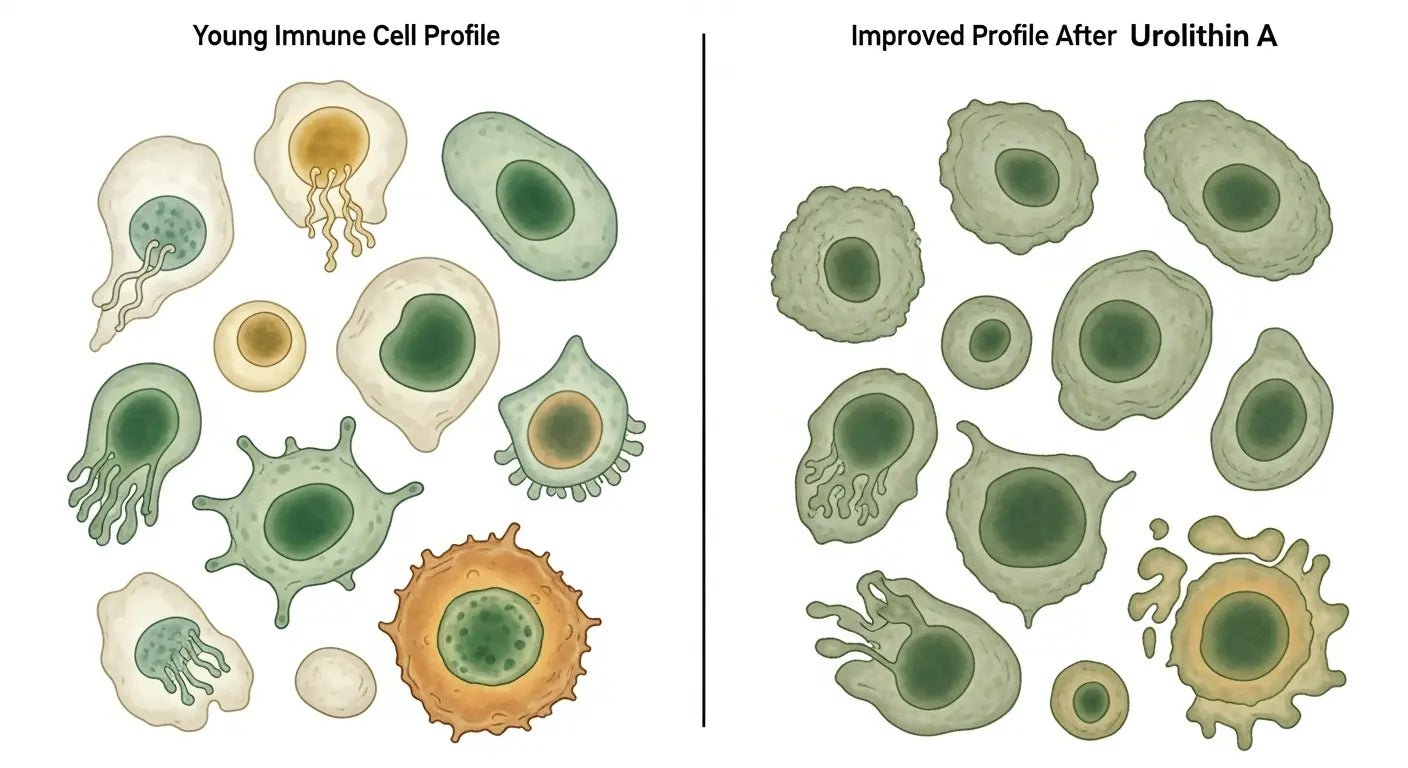
A 2025 trial published in Nature Aging gave 1,000 mg of urolithin A daily to 50 adults aged 45–70 for 28 days and measured changes in immune cell populations. The reported finding was an expansion of naïve CD8+ T-cells and a reduction in markers associated with T-cell exhaustion. It is a small, short, mechanistic study — genuinely interesting, and a long way from a clinical outcome.
This article describes what the trial measured, what it did not, and how it fits alongside the longer muscle-endurance evidence.
Key points
- 50 participants, 28 days, 1,000 mg daily — a mechanistic study, not an outcome trial
- Measured immune cell populations, not infections, illness or vaccine response
- Naïve CD8+ T-cells expanded; exhaustion markers declined
- Proposed mechanism is mitophagy in immune cells
- Muscle endurance remains the better-replicated finding for urolithin A
- Roughly 40–55% of people produce meaningful urolithin A from food
What happens to the immune system with age
Immune cell populations shift over a lifetime. The proportion of naïve T-cells — those not yet committed to a specific target — decreases, while cells showing markers of exhaustion become more common. This shift is well described in immunology and is one of the reasons immune responses differ between a 25-year-old and a 70-year-old.
Mitochondrial function in immune cells is one of several factors discussed in that context, and it is the link that made urolithin A a candidate worth testing here at all.
The 2025 trial, precisely
| Design | Phase 1 randomised, double-blind, placebo-controlled |
|---|---|
| Participants | 50 adults, aged 45–70 |
| Duration | 28 days |
| Dose | 1,000 mg urolithin A daily |
| Measured | Immune cell populations, exhaustion markers and immune metabolic remodelling |
| Reported | Naïve-like, less exhausted CD8+ T-cells expanded by 0.5 percentage points versus placebo; CD8+ fatty acid oxidation capacity rose by 14.7 percentage points |
What the trial did not measure: whether participants had fewer infections, recovered faster, responded better to vaccination, or experienced any change in how they felt. Those questions require different designs, more participants and longer follow-up.
The size of the findings also matters. The immune result was statistically marginal; the metabolic one was more robust. Neither was adjusted for the number of comparisons the study made — with many endpoints measured, some results will clear the significance threshold by chance alone.
A change in a cell population is a biological observation. Presenting it as a health outcome is the most common error in coverage of this study, and we are not going to make it.
Why urolithin A affects immune cells at all
Urolithin A is studied for its effect on mitophagy — the process by which cells clear damaged mitochondria. Immune cells are metabolically demanding, and their function depends on mitochondrial capacity.
The proposed chain is: mitophagy improves mitochondrial quality in immune cells, which supports their metabolic capacity, which is reflected in the population markers measured. Each link is plausible. The trial provides evidence for the later links, not for the chain as a whole.
The conversion problem
Urolithin A is not present in food. Your gut bacteria produce it from ellagitannins found in pomegranates, walnuts and some berries — and only an estimated 40–55% of people carry the bacteria to do so efficiently.
This is why trials use a supplement rather than dietary intake: it is the only way to give every participant a known amount. It is also the practical reason the compound is sold at all.
What the muscle evidence adds
The immune finding is new and unreplicated. The muscle findings are neither.
A 2022 trial reported improvements in muscle strength over four months, at 500 and 1,000 mg daily. A 2024 systematic review covering five randomised trials and around 250 participants found a dose-dependent anti-inflammatory effect and improvements in muscle strength and endurance, but not in physical function.
If you are deciding whether urolithin A is worth taking, the muscle endurance evidence is the more substantial body of work. The immune data is a reason to watch the field, not a reason on its own.
Who this is actually relevant to
Adults in the age range the trials studied — broadly 45 and above — where the biology being measured is present. It is not relevant to acute illness, it is not an alternative to vaccination, and nobody should take it expecting to get fewer colds. That question has not been asked, let alone answered.
If you take prescription medication, are pregnant or breastfeeding, or have an immune condition, ask your doctor or pharmacist first.
Frequently asked questions
How large was the 2025 trial?
50 adults aged 45–70, over 28 days, at 1,000 mg daily. Small and short by clinical standards — appropriate
for a mechanistic question, insufficient for an outcome claim.
Does it mean I will get ill less often?
No. The trial measured immune cell populations, not illness. That question was not studied.
How much do trials use?
1,000 mg daily in the immune trial; muscle trials used 500 or 1,000 mg.
Can I get enough from pomegranates?
Only if you carry the gut bacteria that convert ellagitannins, which an estimated 40–55% of people do.
There is no routine test.
Is it safe with other supplements?
No specific interactions were reported in trials up to four months. Check with your pharmacist if you take
prescription medicines.
Sources
- Urolithin A and age-related immune decline — RCT, PubMed
- Urolithin A and muscle endurance in older adults — JAMA Network Open, PubMed
- Urolithin A and muscle strength — Cell Reports Medicine, PubMed
- Safety and mitophagy activity of urolithin A — first-in-human study, PubMed
- Targeting aging with urolithin A in humans — systematic review, PubMed
- Prevalence of urolithin A producers in healthy adults — RCT, PubMed
Share:
Nattokinase: Evidence-based benefits, risks, and what to know
Summer Skin From Within: The Science of Oral Hyaluronic Acid