
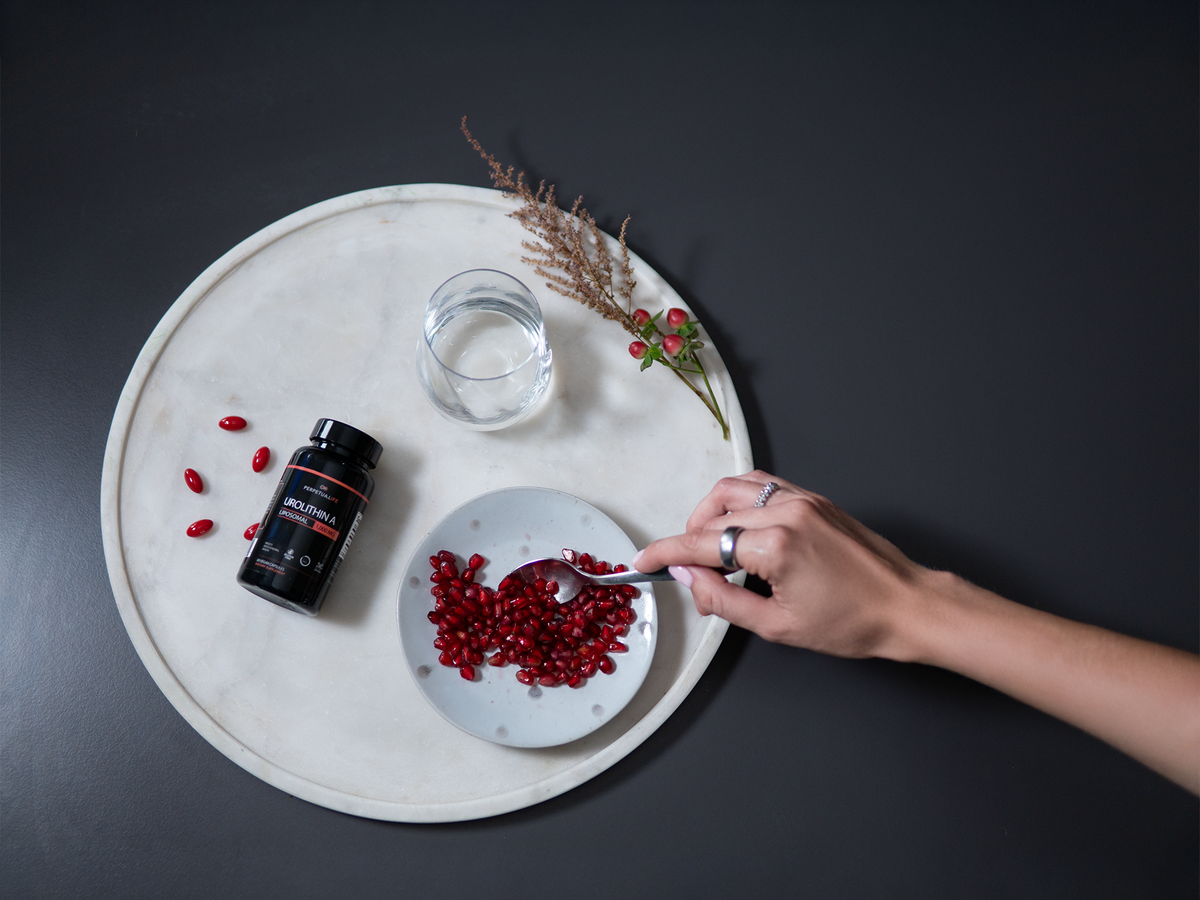
Urolithin A is a compound that gut bacteria make from ellagitannins, which are found in pomegranates, walnuts and some berries. In a 2022 randomised trial of 66 adults aged 65 to 90, 1,000 mg a day for four months improved muscle endurance in a hand and a leg muscle, but did not significantly change the trial's two primary outcomes. The main human trials were co-authored by employees of Amazentis, the company that developed the ingredient.
This article sets out what those trials measured, what they did not, and why eating pomegranates is not a reliable route for most people.
Key points
- Urolithin A is made by gut bacteria; in a 2021 study only about 40% of 100 adults converted pomegranate precursors efficiently
- Human trials have used 10 to 1,000 mg a day for 28 days to four months
- The most consistent finding is muscle endurance and strength; a 2024 systematic review found no effect on physical function
- The evidence is small: five studies with 250 people in total in that review
- Trials enrolled healthy adults only. If you take prescription medicines, or are pregnant or breastfeeding, ask your doctor or pharmacist first
Why can't I just eat pomegranates?
Pomegranates, walnuts and some berries contain ellagitannins, not urolithin A itself. Turning them into urolithin A depends on which gut bacteria you carry.
In a 2021 study of 100 healthy adults, only 12% had detectable urolithin A at the start, and about 40% converted the precursors efficiently after a glass of pomegranate juice. Producers had a more diverse gut microbiome than non-producers. In the same study, a product containing 500 mg of urolithin A gave more than six times the exposure of the juice.
Several authors of that study were employees of Amazentis, which makes the ingredient, so it is not independent evidence.
What is mitophagy, and why does it matter here?
Mitochondria produce most of the energy in your cells. Mitophagy is the process that removes damaged mitochondria so they can be replaced.
Urolithin A was first shown to stimulate mitophagy and improve muscle health in old animals and preclinical models of ageing. That animal work is the reason human trials began; it is not evidence of an effect in people.
What have human trials measured?
Older adults. A 2022 double-blind randomised trial gave 66 adults aged 65 to 90 either 1,000 mg of urolithin A or placebo daily for four months. Muscle endurance, measured as the number of contractions before fatigue, improved in a hand and a leg muscle compared with placebo. The primary outcomes did not differ significantly: six-minute walking distance rose by 60.8 m with urolithin A and by 42.5 m with placebo, and maximal energy production in the hand muscle did not change. C-reactive protein, a marker of inflammation, was lower with urolithin A at four months.
Middle-aged adults. A 2022 randomised trial in middle-aged adults tested two doses for four months. Muscle strength rose by about 12%, but peak power output, the primary outcome, did not improve significantly.
All trials together. A 2024 systematic review of five studies with 250 healthy people found improvements in muscle strength and endurance and a dose-dependent anti-inflammatory effect, but no effect on physical function, cardiovascular outcomes or body measurements.
Who ran the trials. Employees of Amazentis co-authored the older-adult trial, the middle-aged trial and the first-in-human study. That does not make the results wrong, but it is worth knowing when you weigh them.
How much, and for how long?
Across the five studies in the 2024 review, doses ranged from 10 to 1,000 mg a day, for 28 days to four months. In the first-in-human study, four weeks at 500 mg and 1,000 mg changed blood and muscle markers of mitochondrial function.
None of the studies in the review lasted longer than four months, so the effects of longer use are unknown.
Is it safe?
The first-in-human study found a favourable safety profile, and the 2024 review reported only mild or moderate adverse events, which were judged unrelated to urolithin A.
The trials enrolled healthy adults, so there are no data for pregnancy, breastfeeding or people taking prescription medicines. If any of those apply to you, ask your doctor or pharmacist first.
Frequently asked questions
Do I produce urolithin A myself?
Unknown without a test. In a 2021 study, about 40% of adults converted pomegranate precursors efficiently, and only 12% had detectable levels before the test drink.
How much do trials use?
Between 10 and 1,000 mg a day. The four-month trial in older adults used 1,000 mg.
Is pomegranate juice equivalent?
No. Juice supplies precursors, and in the 2021 study a 500 mg urolithin A product gave more than six times the exposure of a glass of juice.
Does urolithin A improve walking or everyday physical function?
Not so far. The 2024 review found no effect on physical function, and the four-month trial in older adults found no significant difference in walking distance.
Can I take it with medicines?
Unknown. The trials enrolled healthy volunteers, so check with your pharmacist if you take prescription medicines.
Sources
- Effect of urolithin A supplementation on muscle endurance and mitochondrial health in older adults: a randomized clinical trial (JAMA Netw Open, 2022)
- Urolithin A improves muscle strength, exercise performance, and biomarkers of mitochondrial health in a randomized trial in middle-aged adults (Cell Rep Med, 2022)
- The mitophagy activator urolithin A is safe and induces a molecular signature of improved mitochondrial and cellular health in humans (Nat Metab, 2019)
- Targeting aging with urolithin A in humans: a systematic review (Ageing Res Rev, 2024)
- Direct supplementation with urolithin A overcomes limitations of dietary exposure and gut microbiome variability in healthy adults (Eur J Clin Nutr, 2021)
Share:
Vitamin D3 and K2: Benefits and How They Work Together
Top longevity biomarkers: evidence-based guide to a healthier life