
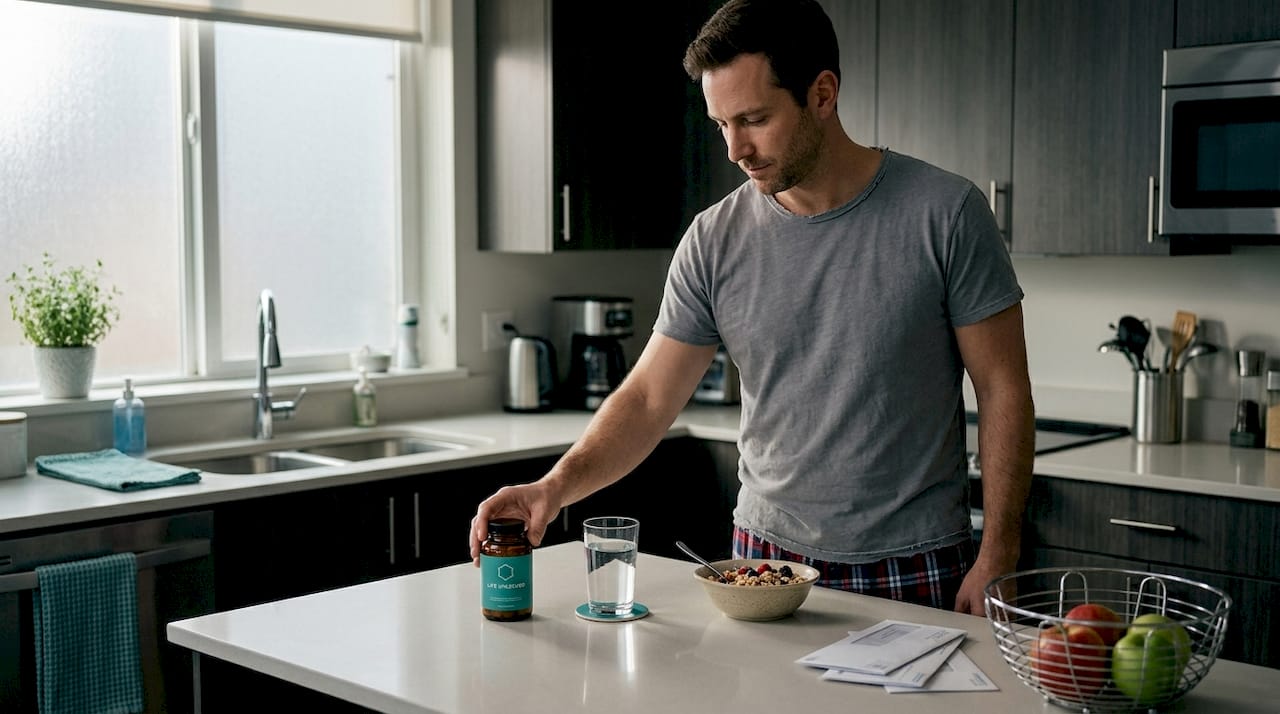
Glycine is the smallest amino acid and one of the most heavily used. It makes up roughly a third of collagen, supplies one of the three components of glutathione, and acts as an inhibitory neurotransmitter. Sleep studies have used 3 g taken before bed; metabolic research has used higher, weight-based amounts under supervision. Your body makes glycine, but synthesis may not match demand.
This guide covers where glycine is used in the body, what the trials measured, what the doses were, and where the evidence is thinner than the enthusiasm.
Key points
- About one-third of collagen is glycine
- One of three amino acids forming glutathione, alongside cysteine and glutamate
- Sleep trials have used 3 g before bed; participants reported easier sleep onset
- Metabolic studies used weight-based doses (around 100 mg/kg/day) in supervised settings
- GlyNAC studies combine glycine with N-acetylcysteine — results belong to the combination, not to glycine
- Trials are small; most enrolled fewer than 30 people
Where your body uses glycine
Collagen. Glycine occupies every third position in the collagen triple helix. No other amino acid fits — the structure requires the smallest one.
Glutathione. Glutathione is a tripeptide of glycine, cysteine and glutamate. Cysteine is usually the limiting component, but glycine availability matters too.
Neurotransmission. Glycine acts as an inhibitory neurotransmitter in the spinal cord and brainstem, and also modulates NMDA receptors. This dual role is why it appears in sleep research.
One-carbon metabolism. Glycine participates in the folate cycle, which supplies methyl groups for a wide range of biochemical reactions.
Do you need more than you make?
Glycine is classed as non-essential because the body synthesises it. Several researchers have argued that synthesis may fall short of full demand — the phrase used in that literature is "conditionally essential".
The argument is a calculation of estimated requirement versus estimated synthesis, not a measured deficiency. It is a reasonable hypothesis and it is worth knowing that it is a hypothesis.
Sleep: the most practical evidence
Trials giving 3 g of glycine before bed reported that participants fell asleep more easily and rated next-day tiredness lower. Animal studies point to a drop in core body temperature as the mechanism, which is consistent with the normal physiology of falling asleep.
These studies were small — typically 10 to 20 participants — and short. The dose is consistent across them, which is useful, and glycine is inexpensive, which makes a personal trial low-cost.
Metabolic research: read the dose carefully
A study in adults with obesity used approximately 100 mg per kilogram of body weight daily for two weeks and reported changes in blood triglycerides and liver enzyme values.
Note what that dose means: for an 80 kg adult, roughly 8 g per day. That is not the 3 g used in sleep research, and it was administered in a supervised study setting. Do not transfer a dose across contexts without knowing what the context was.
GlyNAC: a combination, not glycine
You will see striking percentages attached to glycine — improvements in oxidative stress markers, mitochondrial measures, inflammatory markers. Almost all of them come from GlyNAC studies, which give glycine together with N-acetylcysteine.
Those studies were designed to raise glutathione, which requires both amino acids. The results describe the combination. Attributing them to glycine alone is a straightforward misreading, and it is extremely common.
The trials were also small, mostly in older adults, and ran 16–24 weeks. Interesting, early, and not about glycine by itself.
Safety and how it is taken
Glycine has been well tolerated in trials at the doses described. It dissolves easily and tastes mildly sweet, so powder in water is the usual format.
If you take medication acting on the central nervous system, are pregnant or breastfeeding, or have kidney or liver disease, ask your doctor or pharmacist before starting. Data in those groups are limited.
Frequently asked questions
How much glycine for sleep?
Trials used 3 g about an hour before bed. That is the dose with the most consistent published use.
Can I get enough from food?
Glycine is concentrated in collagen-rich foods — skin, connective tissue, bone broth. Modern diets that
favour muscle meat provide less than diets using the whole animal.
Is glycine the same as collagen?
No. Glycine is one amino acid; collagen is a protein in which roughly a third of the residues are glycine.
Should I take glycine or GlyNAC?
They answer different questions. The striking glutathione results come from the combination, because
raising glutathione needs cysteine as well.
Does it interact with anything?
No major interactions are established, but if you take CNS-active medication, check with your pharmacist.
Sources
- Glycine and daytime performance after sleep restriction, PubMed
- Glycine ingestion and subjective sleep quality — polysomnographic study
- Glycine administration in human adults — systematic review, PubMed
- GlyNAC supplementation in older adults — pilot trial, PubMed
- Glycine supplementation in severe obesity — exploratory trial, PubMed
- Glycine synthesis versus requirement — analysis, PubMed
Share:
5 Reasons Why Ashwagandha Should Be In Your Wellness Routine
NR supplements for longevity: EU-approved, science-backed guide