
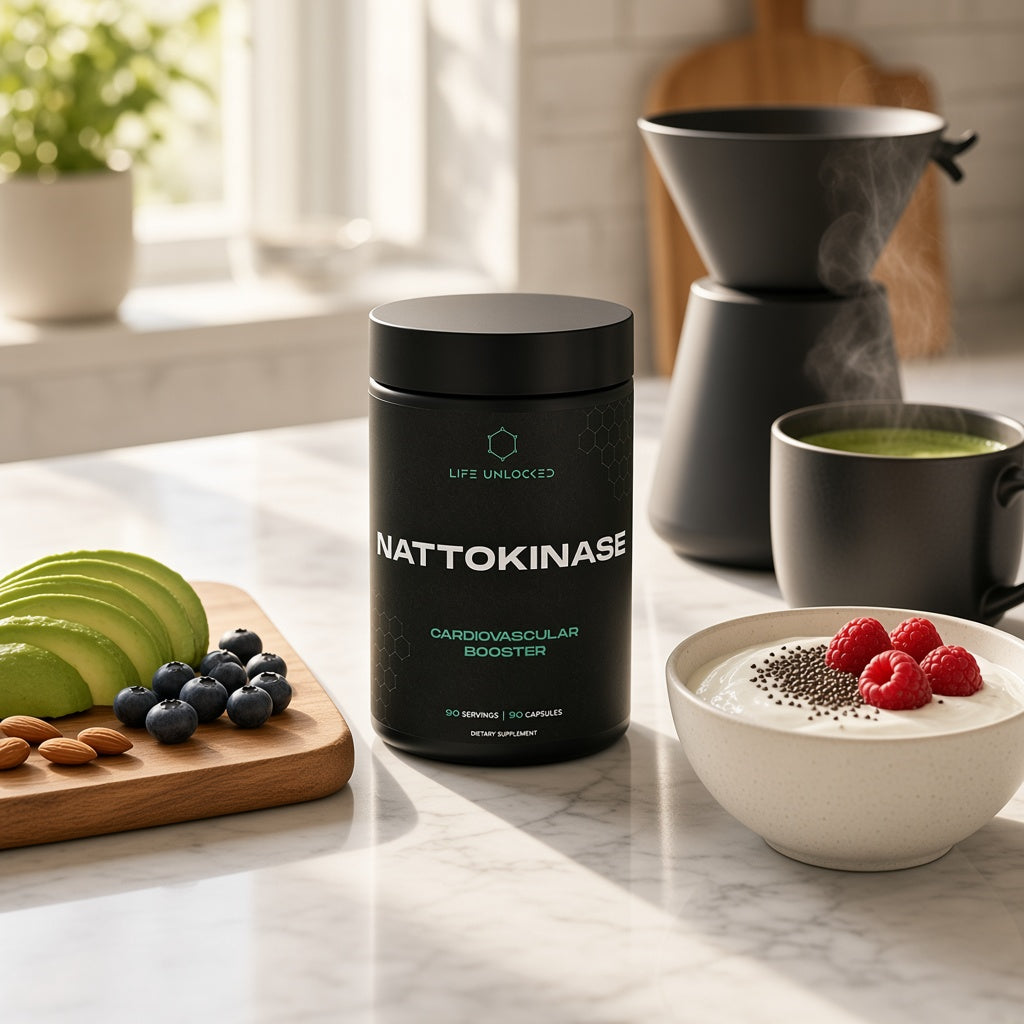
Nattokinase is an enzyme from natto, a Japanese food made by fermenting soybeans with Bacillus subtilis. In randomised, placebo-controlled trials it lowered blood pressure readings, and a single dose measurably changed blood-clotting markers in healthy people. In the largest study so far, 1,062 adults who took 10,800 FU a day for 12 months had 18.1% lower LDL cholesterol and 15.8% higher HDL cholesterol than at the start. The results so far suggest that the dose matters.
This guide covers what the human studies found, why dose appears to be the key variable, what still needs confirming, and who should check with a doctor first.
Key points
- Blood pressure: a 2023 meta-analysis of three randomised trials found average reductions of 3.45 mmHg systolic and 2.32 mmHg diastolic compared with placebo
- Cholesterol: at 10,800 FU a day for 12 months, total cholesterol fell by 15.9%, LDL by 18.1% and triglycerides by 15.3%, while HDL rose by 15.8%
- Dose appears to matter: the same study saw no lipid effect at 3,600 FU a day, and the meta-analysis authors called for trials of higher doses
- Nattokinase acts on blood clotting in people: if you take anticoagulant or antiplatelet medicines, do not use it without your doctor's agreement
- FU measures enzyme activity, not weight, so compare products by their FU value
What is nattokinase?
Nattokinase is a serine protease found in the sticky part of natto. Supplements are labelled in fibrinolytic units (FU), which describe how strongly the enzyme breaks down fibrin in a laboratory test, not how many milligrams a capsule contains. Products of the same weight can carry different FU values, so the FU figure on the label is the one to compare.
Does it work in people, not just in the laboratory?
Yes, it is active in the body. In a 2015 placebo-controlled crossover study, 12 healthy young men took a single 2,000 FU dose. D-dimer, a breakdown product of fibrin, rose by 44.5% at six hours, and the activated partial thromboplastin time, a standard clotting test, was prolonged. The effect lasted for more than eight hours, and all values stayed within the normal range.
Blood pressure
A 2008 randomised, double-blind trial in Korea gave 86 adults aged 20 to 80 with pre-hypertension or stage 1 hypertension 2,000 FU a day or placebo for eight weeks; 73 completed it. Compared with placebo, systolic pressure fell by 5.55 mmHg and diastolic pressure by 2.84 mmHg, and renin activity also fell. The capsules were supplied by their manufacturer, Japan Bio Science Laboratory.
A 2023 meta-analysis pooled three randomised trials, with 115 people on nattokinase and 108 on placebo, and found average reductions of 3.45 mmHg systolic and 2.32 mmHg diastolic. The authors noted that the number of trials is still small.
Cholesterol: why the dose matters
The largest study of nattokinase so far, published in 2022, followed 1,062 adults aged 63 to 85 in China who took 10,800 FU a day for 12 months. Compared with their own starting values, total cholesterol fell by 15.9%, LDL cholesterol by 18.1% and triglycerides by 15.3%, while HDL cholesterol rose by 15.8%. In the 683 participants who had carotid ultrasound, the average thickness of the artery wall fell from 1.33 mm to 1.04 mm. No noticeable adverse effects were recorded.
The same study found no lipid effect at 3,600 FU a day. That matches the randomised trials: the 2023 meta-analysis saw no improvement in blood lipids with the shorter, lower-dose regimens, and its authors suggested that the effect on lipids may increase with dose and called for long-term, high-dose trials.
What still needs confirming
The 10,800 FU study had no placebo group: the authors analysed the records of people who were already taking nattokinase, and several of them were employed by Sungen Bioscience, the company that made the tablets. A randomised trial at that dose would be the next step.
At the lower dose of 2,000 FU, a 2021 randomised trial in 265 adults at low cardiovascular risk, median age 65, found no difference from placebo in carotid artery measurements, blood pressure or laboratory values after a median of three years. Together with the 3,600 FU result, this is consistent with the idea that low doses are not enough for these outcomes.
Who should check with a doctor first?
Because nattokinase acts on blood clotting, do not add it to an anticoagulant such as warfarin or a direct oral anticoagulant, or to an antiplatelet medicine such as aspirin, without your doctor's agreement. Tell your doctor before any planned surgery. The studies described here did not include pregnancy or breastfeeding, so ask your doctor or pharmacist first in those situations.
Frequently asked questions
Does nattokinase lower blood pressure?
Yes, modestly, in the randomised trials so far: on average by 3.45 mmHg systolic and 2.32 mmHg diastolic compared with placebo, in three trials pooled in a 2023 meta-analysis.
Does nattokinase lower cholesterol?
Partly. At 10,800 FU a day for 12 months, LDL cholesterol was 18.1% lower than at the start, but that study had no placebo group. At lower doses, randomised trials have not shown a lipid effect.
What dose do studies use?
Randomised trials used 1,200 to 8,000 FU a day; the largest study used 10,800 FU a day.
Can I take nattokinase with blood thinners?
Not without your doctor's agreement. A single 2,000 FU dose changed clotting tests in healthy men, so the combination needs medical oversight.
Is eating natto the same?
Not exactly. Natto contains the enzyme, but food is not labelled in FU, so you cannot tell how much activity a portion provides.
Sources
- Effective management of atherosclerosis progress and hyperlipidemia with nattokinase: a clinical study with 1,062 participants (Front Cardiovasc Med, 2022)
- Nattokinase supplementation and cardiovascular risk factors: a systematic review and meta-analysis of randomized controlled trials (Rev Cardiovasc Med, 2023)
- Effects of nattokinase on blood pressure: a randomized, controlled trial (Hypertens Res, 2008)
- A single-dose of oral nattokinase potentiates thrombolysis and anti-coagulation profiles (Sci Rep, 2015)
- Nattokinase atherothrombotic prevention study: a randomized controlled trial (Clin Hemorheol Microcirc, 2021)
Share:
Nicotinamide Riboside (NR) in the EU: What Is Authorised and What Trials Show